Most of us have heard the cry before.
“My God, my God, why hast thou forsaken me?”
Those words are often spoken softly in sanctuaries, or read slowly beside a hospital bed, as though they belong only to moments of grief. But when Jesus spoke them from the cross, He was doing more than expressing pain. He was opening Psalm 22.
And once that psalm is opened, we begin to see the cross differently.
Not as an accident.
Not as a tragedy spiraling out of control.
But as the place where suffering and redemption meet.
Buried within the psalm is a phrase that feels almost unsettling:
“But I am a worm, and no man.”
Why would the Son of God choose such language?
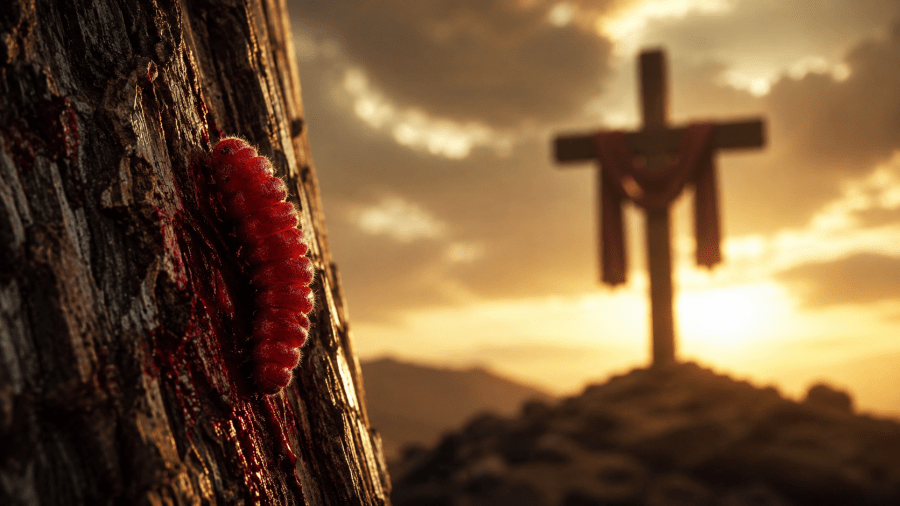
The Hebrew word used for “worm” is tolaʿath, a word associated with the crimson worm and the scarlet dye known throughout the ancient world.
For generations, a tradition surrounding the crimson worm has been passed quietly from believer to believer, and I find it deeply moving. The story tells of the worm fastening itself to wood, giving its life so that its young might live, leaving behind a crimson stain upon the wood.
Ancient Israel already connected tolaʿath with scarlet sacrifice and cleansing. Scarlet thread woven into the tabernacle curtains. Blood sprinkled before the altar. Sin that stained deeply, and mercy that reached deeper still.
And standing beneath the shadow of the cross, it becomes difficult not to see the beauty hidden in the sorrow.
Christ fastening Himself to wood.
Christ pouring out His life so others might live.
The cross tells the truth about us.
We are more broken than we admit. More wounded than we appear. We spend much of life trying to cover our emptiness with accomplishment, noise, control, or religion itself. Yet the cross quietly reveals that the human heart cannot heal itself.
Humanity did not need mild correction.
We needed rescue.
And still, the mystery of the gospel is that God did not move away from our brokenness. He entered it.
The eternal Son allowed Himself to be rejected, humiliated, wounded, and lifted up before the world He created. Not because love demanded nothing, but because love was willing to give everything.
There is something deeply personal about that.
Because most of us know what it feels like to fear rejection. To wonder if we are truly seen. To carry private shame no one else notices. We spend years trying to prove we are enough.
But at the cross, God was not asking humanity to climb upward toward Him.
He was descending toward us.
That is why the cross still unsettles us when we stop long enough to truly look at it.
It strips away illusion.
It tells us that sin is costly.
But it also tells us that mercy is deeper than our failure.
Christ was forsaken so we could be welcomed.
Christ was wounded so we could be healed.
Christ entered darkness so we would never face it alone.
And perhaps that is the deepest mystery of all:
The God who seemed absent in Psalm 22 was actually drawing near, carrying our sorrow, bearing our sin, and opening the way home.

