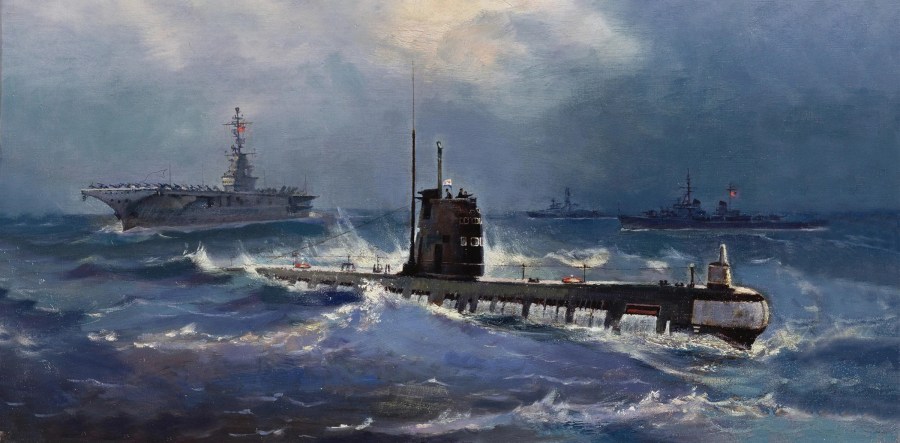
In 1962, the world came closer to nuclear war than most of us realize. During the Cuban Missile Crisis, a Soviet submarine slipped beneath the ocean, cut off from communication with Moscow. Above it, the U.S. Navy dropped depth charges. They were not intended to destroy the submarine, but to force it to surface. Inside the vessel, with no context and no contact, it sounded like war had already begun.
What the Americans did not know was that the submarine carried a nuclear torpedo powerful enough to devastate an entire fleet. Launching it was not a reflexive act. It required agreement. Three senior officers each held a launch key, and all three had to consent. Two of the officers believed the moment had arrived. They read the signs, trusted their instincts, and prepared to act.
The third officer was Vasili Arkhipov.
Under intense pressure and direct threat from his superior, Arkhipov refused to turn his key. He was not convinced war had begun. More importantly, he understood that some decisions do not allow for correction. Once made, they echo. His refusal broke the chain. One man’s restraint interrupted momentum and prevented a decision the world could not have absorbed.
That moment endures because it reveals how catastrophe usually unfolds. Most disasters do not begin with evil intentions. They begin with impulse. With urgency that outruns wisdom. With pressure that insists something must be done now. Good intentions are often present. They are simply overtaken. We tend to assume courage always announces itself through action. Sometimes it does. But sometimes courage waits.
Most of us will never sit in a steel submarine with launch codes in our hands. But we do stand at quieter crossroads more often than we realize. The pressure is rarely external. More often, it rises from within. It is the tug to protect our image, the urge to justify a sharp word, the decision to nurse a resentment, or the temptation to choose what is easy instead of what is true. We find ourselves saying yes to anger because it feels justified, yes to silence because it feels safer, yes to compromise because it seems harmless.
In those moments, the struggle is not with others. It is within us. The call is not to defiance, but to self-governance. One unchecked impulse, one unchallenged rationalization, one hurried decision can shape far more than we imagine. And often, the most faithful response is not spoken for anyone else to hear. It is spoken softly, firmly, and finally, in the heart.
Scripture understands this kind of moment well.
Self-control is a mark of spiritual maturity, not weakness.
Strength is not measured by speed of response, but by command of spirit. Scripture warns that the one who lacks restraint is “like a city that is broken down, and without walls” (Proverbs 25:28). The person who can pause under pressure is not passive. He is steady. The question is not whether urgency is felt, but whether urgency is allowed to rule. The Spirit produces “temperance,” a quiet strength that holds when impulse demands release (Galatians 5:22–23).
Obedience to God often begins with resisting hurried impulses.
Faithfulness is not only tested by what others demand, but by what urgency demands within us. Daniel did not wait for pressure to decide. He “purposed in his heart” before the moment arrived (Daniel 1:8). Scripture warns us to guard the heart, because “out of it are the issues of life” (Proverbs 4:23). When urgency is unchecked, it becomes direction, and impulse becomes action (James 1:14–15). Obedience, then, is often the quiet discipline of slowing down and refusing to let urgency decide for us.
Not every permissible action is wise or right.
Scripture draws a clear distinction between what is allowed and what is good. Paul reminds us that “all things are lawful,” but also that “all things are not expedient” and “all things edify not” (1 Corinthians 10:23). Wisdom asks more than whether something can be done. It asks what it will shape, what it will cost, and what it will honor. True wisdom shows itself through “meekness,” choosing what builds rather than what merely satisfies (James 3:13).
History remembers Arkhipov because he understood something rare. Not every moment calls for action. Not every option should be exercised. Some decisions cannot be undone, only restrained.
Most faith-defining moments will never feel heroic. They come softly, disguised as pressure, urgency, or sensible compromise. There is no applause for restraint, no recognition for what never happens.
Wisdom often sounds like silence.
Courage sometimes speaks in one quiet word.
No.
 A Good Word