
(Reflections from Sunday’s Message)
They dragged her into the temple that morning.
Dust swirled around her feet, shame clung to her shoulders.
The crowd pressed close, their fists heavy with stones and hearts heavier with judgment.
She was guilty, they said. The law was clear. The punishment was death.
And then there was Jesus.
He didn’t raise His voice. He didn’t meet accusation with argument.
John writes it simply, almost quietly:
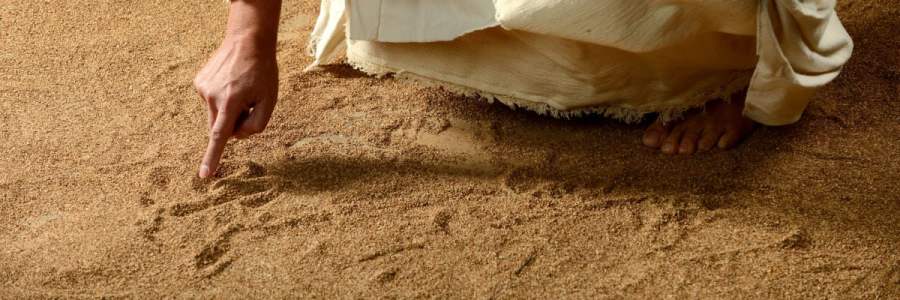
“Jesus stooped down, and with his finger wrote on the ground, as though he heard them not.”
While others shouted, He stooped.
It is one of the most tender scenes in Scripture—heaven bending down to meet humiliation. The word John uses, katakyptō, means to bend with intention, to lower oneself on purpose. Like a father kneeling to lift his child. Like a judge leaning forward to speak mercy instead of judgment.
He stooped not because He was weak, but because we are.
The proud stood tall, gripping stones. The Holy One bent low, holding grace.
The first time God stooped to the dust, He formed us.
This time, He stooped to save us from the dust of death.
And then, He wrote.
Roman judges would write their verdict before reading it aloud.
The decision—called the sententia—was settled before it was spoken.
When Jesus wrote in the dust, He wasn’t stalling for time.
He was rendering judgment. Quietly. Justly. Mercifully.
They thought they were putting Him on trial. But He was holding court.
The true Judge of Heaven and Earth bent low before a trembling sinner who could not lift her eyes. The verdict had already been decided in His heart—not death, but mercy.
Early church father Jerome once suggested that Jesus wrote the sins of the accusers in the dust. Perhaps. Or perhaps God left those words unwritten so that every heart might find its own reflection there. The silence itself was His sermon—humility before hostility, patience before pronouncement. Grace never rushes to condemn; it kneels to restore.
And then—He wrote on the ground.
Not on parchment. Not on stone. But on the earth itself.
The same ground His hands once shaped in Genesis.
The same dust that once became a man.
The earth that had first felt the touch of the Creator now felt the touch of the Redeemer.
Once His fingers formed life from the dust; now they traced grace into it.
Once He stooped to give us breath; now He stooped to give us mercy.
No thunder from Sinai. No tablets of stone. Just a whisper in the dirt.
Creation met its Creator again—and this time, He came not to command, but to forgive.
He stooped that day in the temple, and He would stoop again on Calvary.
The same hands that pressed into the dust would soon be pierced for it.
The Judge who bent beside a guilty woman would soon hang between guilty men.
And that is the miracle of it all.
The wonder of that morning was not in what His finger wrote,
but in what His heart revealed.
That holiness wears humility like a crown.
That the Almighty does not watch from the heavens—He kneels in the dust.
That the hand that hung the stars would press into the soil to lift the fallen.
And in that stooping, grace rewrote the story of the world.
For when He bends toward the broken, everything begins again.
 A Good Word